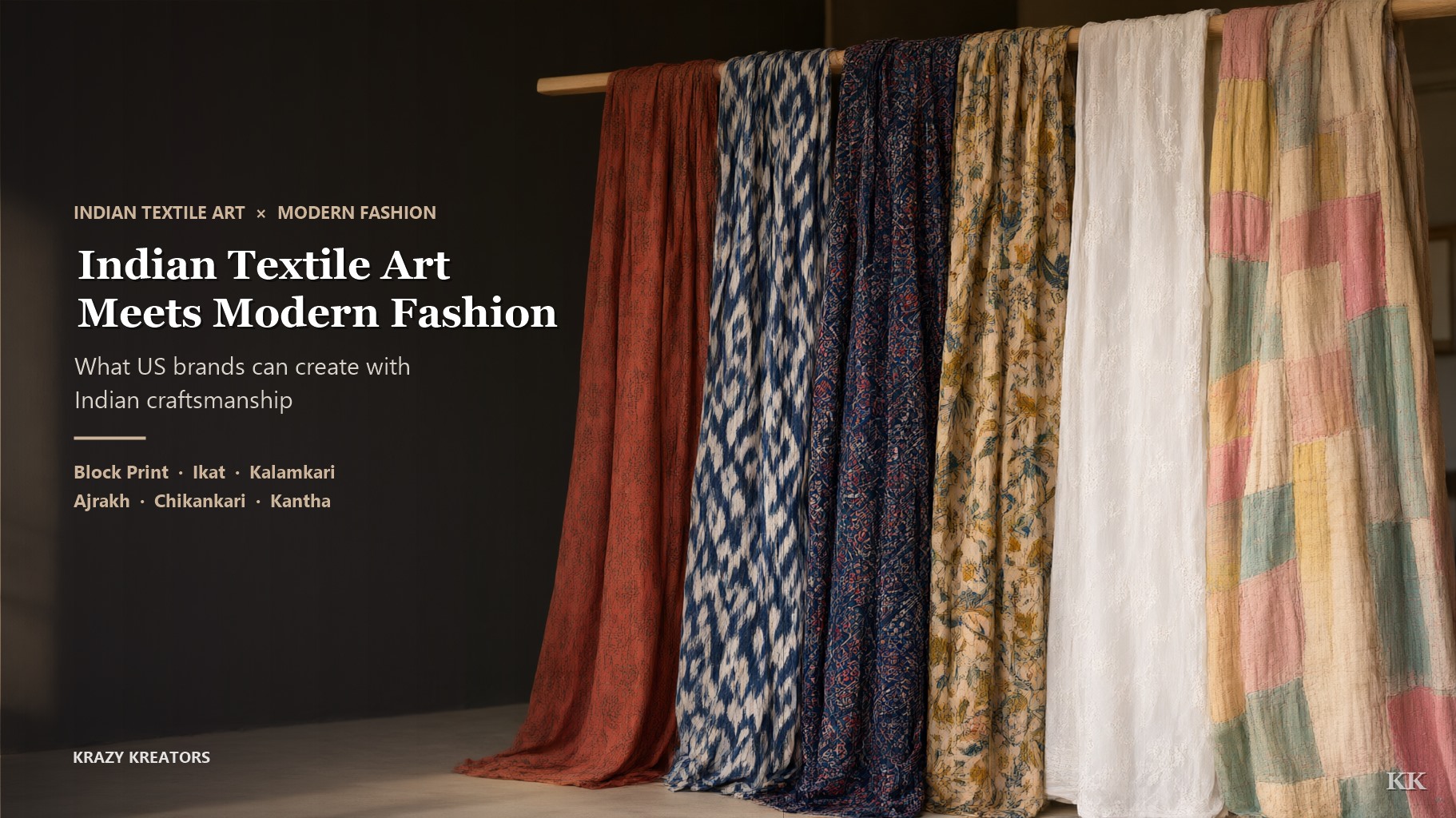
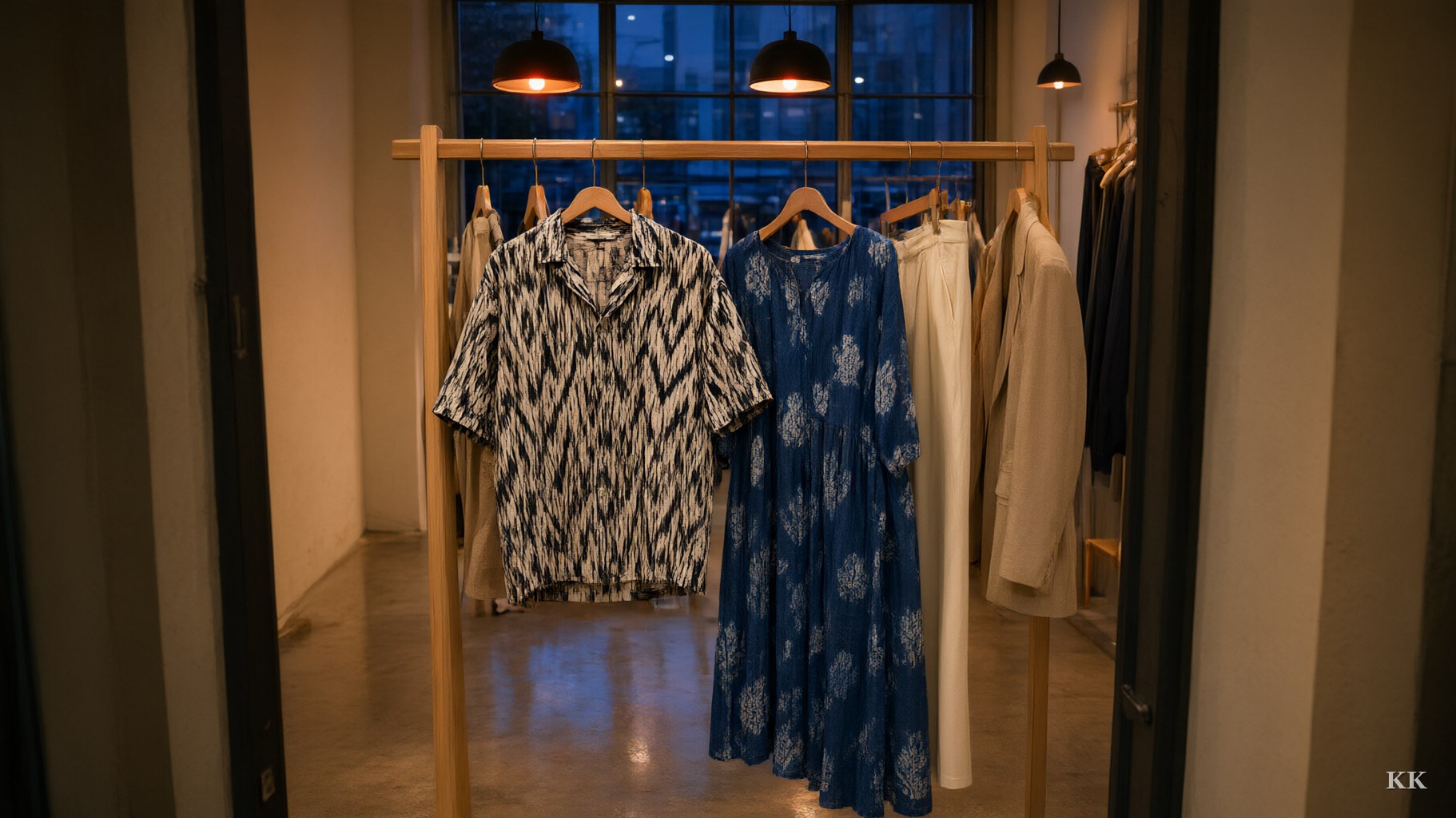
A length of Ajrakh leaves Kutch after weeks of printing, dyeing and washing. Cut into a boxy shirt and hung on a rail in Brooklyn, it looks like nothing else there. That is the appeal of Indian textile art for a US label.
India is the world’s sixth-largest exporter of textiles and apparel (PIB, March 2026), and it still has 35.22 lakh, about 3.5 million, handloom weavers and allied workers (Ministry of Textiles via PIB). Most of what it ships is mill-made. This piece is about the hand-made part.
If you are still deciding whether to source from India at all, start with our companion piece on Indian textiles.
Why Indian Textile Art Is Gaining Attention in Global Fashion
Each region has its own technique, and many are legally tied to their place. Lucknow Chikan, Pochampally Ikat, Kutch Ajrakh, Bagru hand block print, both Srikalahasti and Machilipatnam Kalamkari, and West Bengal’s Nakshi Kantha are all registered Geographical Indications, India’s protection for goods that come from a specific region (IP India GI register).
For a brand selling limited runs, hand-made cloth is hard for a competitor to copy, and it gives the product page something true to say, as long as the claim is accurate.
6 Indian Textile Crafts US Fashion Brands Can Explore
The chart covers all six; the notes under it add what a chart can’t.
Six Indian crafts at a glance
Where each comes from, how it’s made, what it suits, and the one thing to watch
Hand block printing
Bagru & Sanganer, Rajasthan
Carved wooden blocks, one per colour, stamped by hand
Best for
Dresses, shirts, scarves, resortwear
Watch for
Screen prints sold as block prints
GI: Bagru Hand Block Print · Sanganeri Hand Block Printing
Ikat
Pochampally, Telangana
Yarn tied and dyed before weaving, so edges blur
Best for
Camp shirts, overshirts, light jackets
Watch for
A new design means a new warp
GI: Pochampalli Ikat
Kalamkari
Srikalahasti & Machilipatnam, Andhra Pradesh
Drawn with a bamboo pen or block printed, filled with natural dyes
Best for
Statement panels, printed dresses
Watch for
Sacred motifs need the artisans' guidance
GI: Srikalahasthi Kalamkari · Machilipatnam Kalamkari
Ajrakh
Kutch, Gujarat
Resist printing, then rounds of indigo and madder dyeing and washing
Best for
Scarves, shirts, lined jackets
Watch for
The process takes weeks
GI: Kutch Ajrakh
Chikankari
Lucknow, Uttar Pradesh
White-thread hand embroidery on fine cotton
Best for
Occasionwear, premium shirting
Watch for
Heavy work is slow and costly to make
GI: Lucknow Chikan Craft
Kantha
West Bengal
Layers of cloth held with rows of running stitch
Best for
Chore jackets, bags, overshirts
Watch for
Layers can shrink unevenly
GI: Nakshi Kantha
1. Hand Block Printing
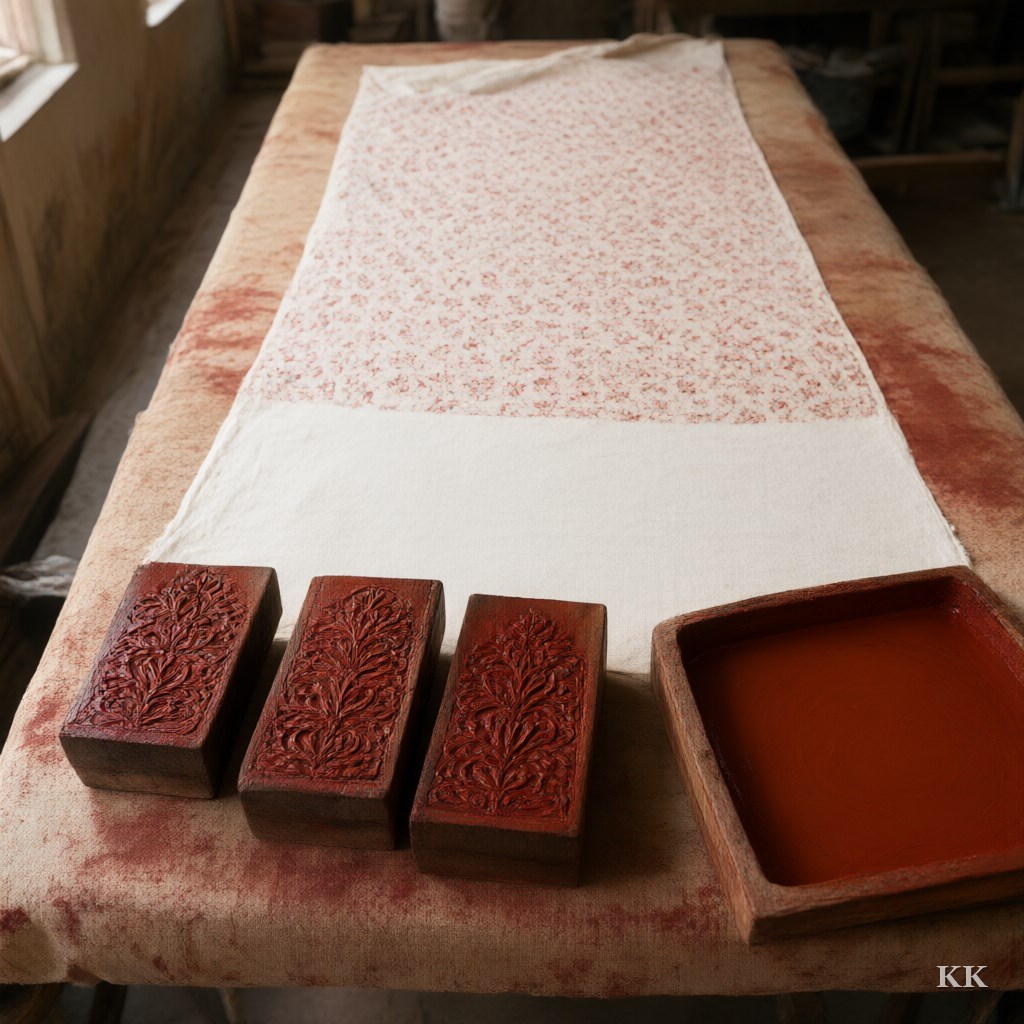
Printers carve the pattern into wooden blocks, one per colour, and stamp it along the cloth by hand. Blocks can be cut from your own artwork, so the print is yours. Ask to see them, because plenty of “block print” cloth is screen printed to look the part. See our print options.
2. Ikat
The yarn is tied and dyed before weaving, so the pattern is woven in and its edges blur. A bold ikat suits a camp-collar shirt or an unstructured jacket. Because the design lives in the yarn, changing it means a new warp, so settle colourways early.
3. Kalamkari
The name means “pen work”. In Srikalahasti the outlines are drawn freehand with a bamboo pen; in Machilipatnam they are block printed. Much of the imagery comes from temple stories, so ask the artisans which motifs suit a commercial garment.
4. Ajrakh
Ajrakh is resist printed, then dyed and washed repeatedly until the dense geometry and deep indigo and red build up. It belongs in a premium or slow-fashion line, not on a tight delivery date.
5. Chikankari
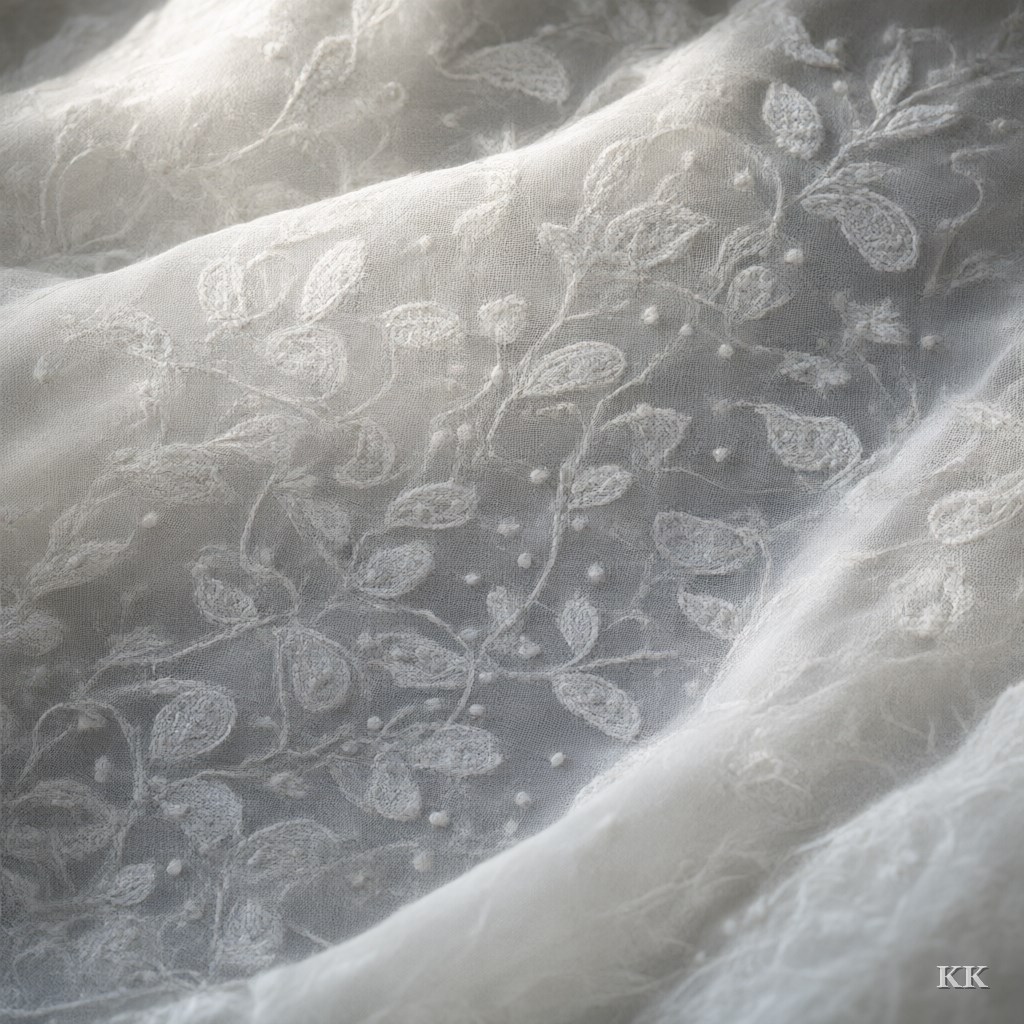
White-thread embroidery from Lucknow, traditionally on fine cotton. It reads as quiet luxury on a shirt yoke or an occasionwear panel. Every stitch is by hand, so heavy work is slow. More on hand embroidery.
6. Kantha
Kantha began as a way to layer old saris into a quilt with running stitch. The rippled surface suits jackets, bags and overshirts. Wash a sample before you grade the pattern, because layered cloth can shrink unevenly.
What Can US Fashion Brands Create With Indian Craftsmanship?
Start from the product you already sell and find the craft that fits it.
| Product category | Indian craftsmanship opportunity |
|---|---|
| Dresses | Block prints, Kalamkari, embroidery |
| Shirts | Ikat, hand block printing |
| Jackets | Kantha, handwoven textiles |
| Scarves | Block printing, Ajrakh |
| Bags | Kantha, handwoven fabrics |
| Resortwear | Lightweight printed textiles |
| Home-fashion collections | Handcrafted Indian fabrics |
From Traditional Craft to Modern Fashion Collection
Colour does most of the modernizing. Ajrakh in its usual indigo and red reads as heritage. Run the same block in one dark colour on undyed cotton and it reads as a contemporary print. Keep the motif and its structure, and change the palette, the scale and the cut.
Most first attempts go wrong at step 2: brands start from a craft they love, then look for someone to sell it to.
“Keep the technique as it is. Change the colour, the scale and the cut.”
Why US Fashion Brands Are Exploring Indian Textile Manufacturing
One country can supply mill cotton for basics, craft cloth for hero pieces, and the units to cut and sew both. Hand workshops make short lengths, which suits a capsule. Since 24 July 2026, Indian apparel pays the normal US duty plus a 10% Section 301 duty, the lower of the two new tiers (USTR).
For duty, lead times and how India compares with Vietnam and Bangladesh, see our India sourcing guide.
Indian Craftsmanship and Sustainable Fashion
Part of the case is real. A handloom runs without power, and a well-made piece gets kept. But handmade is not automatically sustainable. Natural dyeing uses a lot of water and mordants (metal salts that fix dye), a hand print can sit on conventional cotton, and conditions vary between workshops.
The FTC’s Green Guides warn US sellers off broad claims like “eco-friendly” (FTC). Claim only what you can document. Our sustainability page sets out what we check.
Free download
The Craft Sample Test Sheet
A one-page sheet for your first craft sample: the wash, rub and shrinkage checks for each of the six techniques, with space to note what passed.
How US Brands Can Source Indian Textiles Successfully
Define Your Product Requirements
Fabric, quantity, weight in GSM (grams per square metre), colours, decoration and target cost, written down before you contact anyone. A tech pack holds it in one file.
Request Samples
Wash it the way your customer will, then check colour and shrinkage. Natural dyes can bleed in the first wash; better to learn that now than from a return.
Discuss Customization
Prints, colours, private label, packaging and labelling can all be yours. Ask which parts the craft fixes and which it leaves open.
Verify Production & Quality Standards
Check capacity, quality control, lead times and export experience. Every garment sold in the US needs a label giving its fibre content and country of origin (FTC). If you want to say “handloom”, ask whether the cloth carries India’s India Handloom Brand label or the Handloom Mark.
The Indian textile sourcing checklist
Four stages, in order, before you approve production
Define your product requirements
- Fabric type
- Quantity
- GSM / weight
- Colours
- Print or embroidery
- Target price
Request samples
- Fabric quality
- Colour consistency
- Shrinkage after washing
- Durability and rub test
Discuss customization
- Custom prints
- Custom colours
- Private-label manufacturing
- Packaging and labelling
Verify production & quality
- Manufacturing capacity
- Quality-control process
- Lead times
- Export experience
- Documents and compliance
Why Storytelling Matters When Using Indian Textile Art
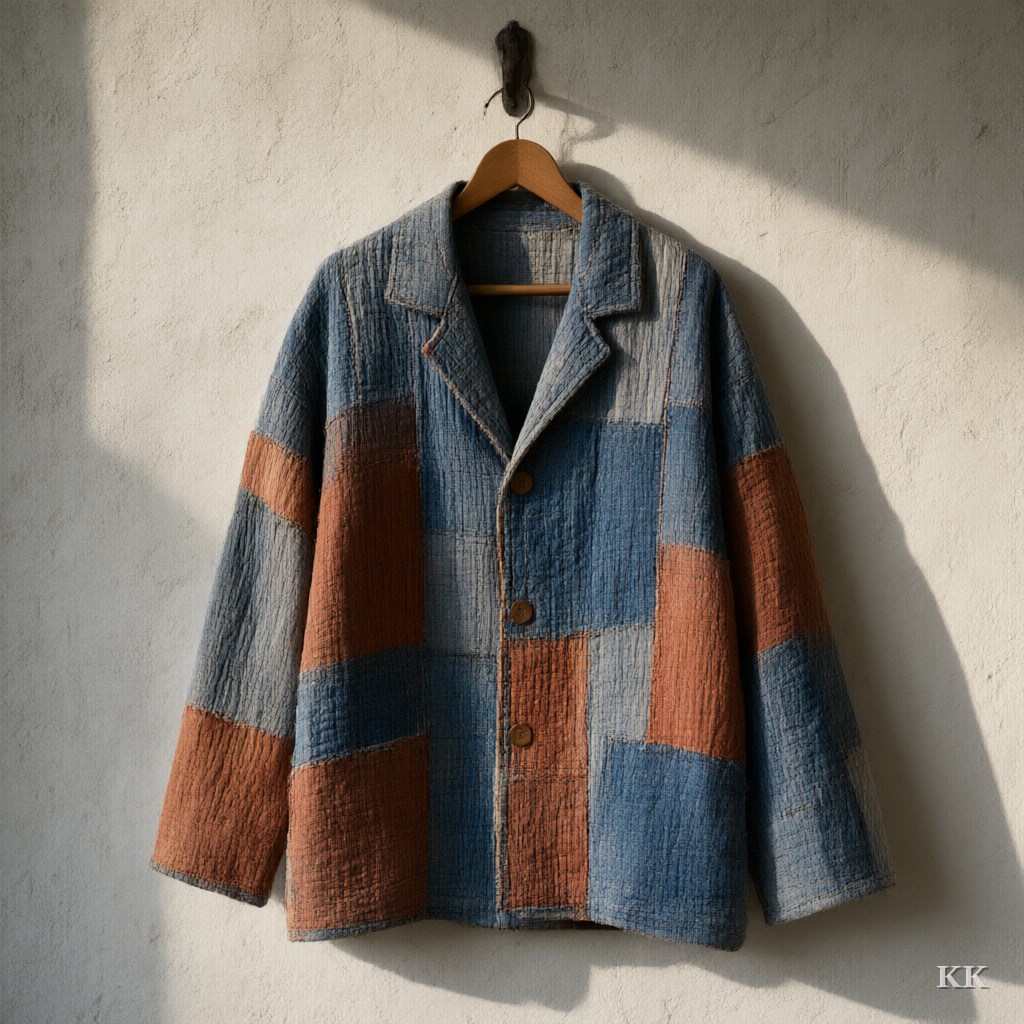
Name the technique, the place and what was done by hand. “Kantha-quilted in West Bengal, every stitch by hand” is specific and checkable. Use the same wording on the product page, hangtag, social posts and stockist pitch.
Credit the craft rather than passing the pattern off as your own idea, and don’t use a protected name like “Lucknow Chikan” unless the work really comes from there.
Indian Textile Art + Modern Design = New Opportunities for US Brands
These pairings are a starting point. Not every one will suit your customer, so sample one before you build a capsule around it.
Indian heritage + contemporary design
How Krazy Kreators Can Help US Fashion Brands
Krazy Kreators works with US clothing founders from first sketch to delivered carton, manufacturing in India. We handle textile sourcing and custom development, sampling, garment manufacturing and bulk production, and we fit the craft to your design rather than the other way round.
Planning your next collection?
Looking to bring Indian craftsmanship into your next fashion collection? Explore custom textile and manufacturing possibilities with Krazy Kreators.
FAQs About Indian Textile Art and Fashion
What is Indian textile art?
The hand techniques India's regions use to pattern and decorate cloth: block printing, ikat weaving, Kalamkari painting, Ajrakh resist printing, and embroidery such as Chikankari and Kantha. Many are tied to a place, and several are registered Geographical Indications under Indian law.
Which Indian textiles are popular with international fashion brands?
Hand block prints and ikat are the easiest to work into a modern line because they read well on simple shapes. Chikankari is used for occasionwear and premium shirting, Kantha for jackets and bags, and Ajrakh and Kalamkari for smaller statement pieces.
Can US fashion brands customize Indian textiles?
Yes, within what each craft allows. Blocks can be carved to your artwork, colours matched to your references, and embroidery placed where your design needs it. Ikat is the least flexible, because the pattern is dyed into the yarn before weaving.
Is Indian textile manufacturing suitable for small fashion brands?
Often, yes. Hand-made cloth is usually produced in short lengths anyway, which suits a capsule or a first run. The trade-off is time: hand processes take longer than machine printing, so build that into the calendar.
How can US brands source Indian textiles?
Write down the fabric, quantity, weight, colours, decoration and target cost; request and wash-test samples; agree what can be customized; then check the manufacturer's capacity, quality control, lead times and export paperwork before you approve production.
What Indian crafts can be used in modern clothing?
Most of them. Block prints on shift dresses and camp shirts, ikat on overshirts, Kantha quilting on chore jackets, Chikankari on a shirt yoke, Ajrakh on scarves and shirts. The craft stays the same; the cut, the scale and the colour are where you modernize it.
How can brands ensure responsible textile sourcing from India?
Visit or audit the workshop, ask how dye water is handled, hold certificates for any fibre claim, and check whether handloom cloth carries the government's Handloom Mark or India Handloom Brand label. Only make the claims your documents support.
Conclusion
Indian textile art gives a US label something its competitors can’t reorder, and a true story to tell about it. Getting there takes a clear spec, patient sampling and claims you can back up. If you could put one of these six crafts into your next drop, which would it be?
When you’re ready, start your project with Krazy Kreators.
About Krazy Kreators
Krazy Kreators is the end-to-end brand-building partner for US clothing founders — design, sampling, fabric sourcing, and retail-grade production, and packaging, under one roof, from first sketch to shelf. krazykreators.com
Read next
9 min read
What the 2026 Met Gala Taught US Fashion Founders About Craft
Why hand work is reading as value again on the US rail.
9 min read
The 'Made in India' Trend Reshaping American Luxury in 2026
How Indian craft moved from the souvenir shelf to the luxury rail.
5 min read
EU Green Claims Directive 2026: What Fashion Brands Must Prove
What a sustainability claim needs on file before it goes on a hangtag.
Comments
No comments yet
Be the first to share your thoughts!