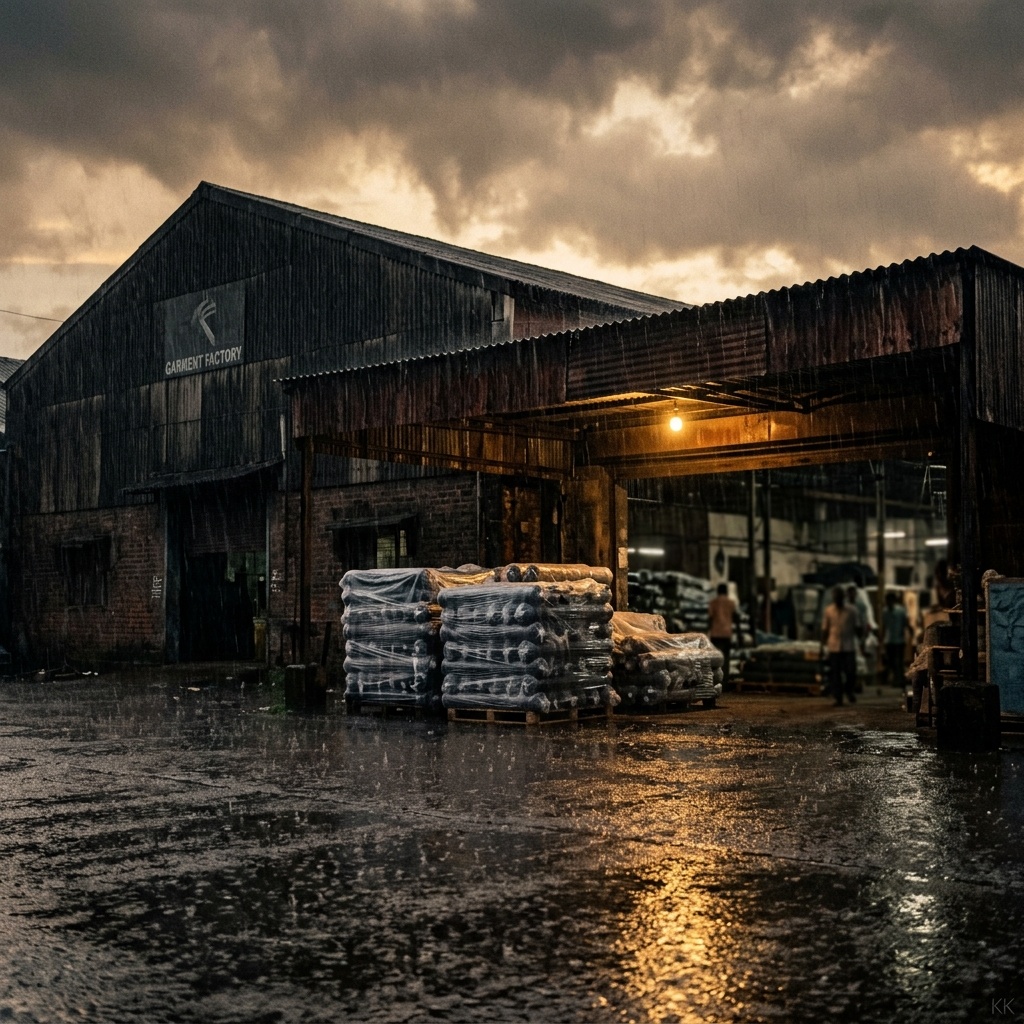
Your holiday and December orders aren't made in October. They're cut, dyed, and finished in July and August — the middle of monsoon — in the same factories that will hand them to a vessel by mid-September.
That seasonal collision is what makes this a different production conversation than any other quarter. Rain doesn't just delay shipments — it shifts how fabric absorbs dye, how garments dry, and which finishing techniques hold up.
If your supply partner's answer to "how does the schedule change in monsoon?" is anything short of specific, you are paying for that absence of plan in December.
The June–September window every US brand is paying for
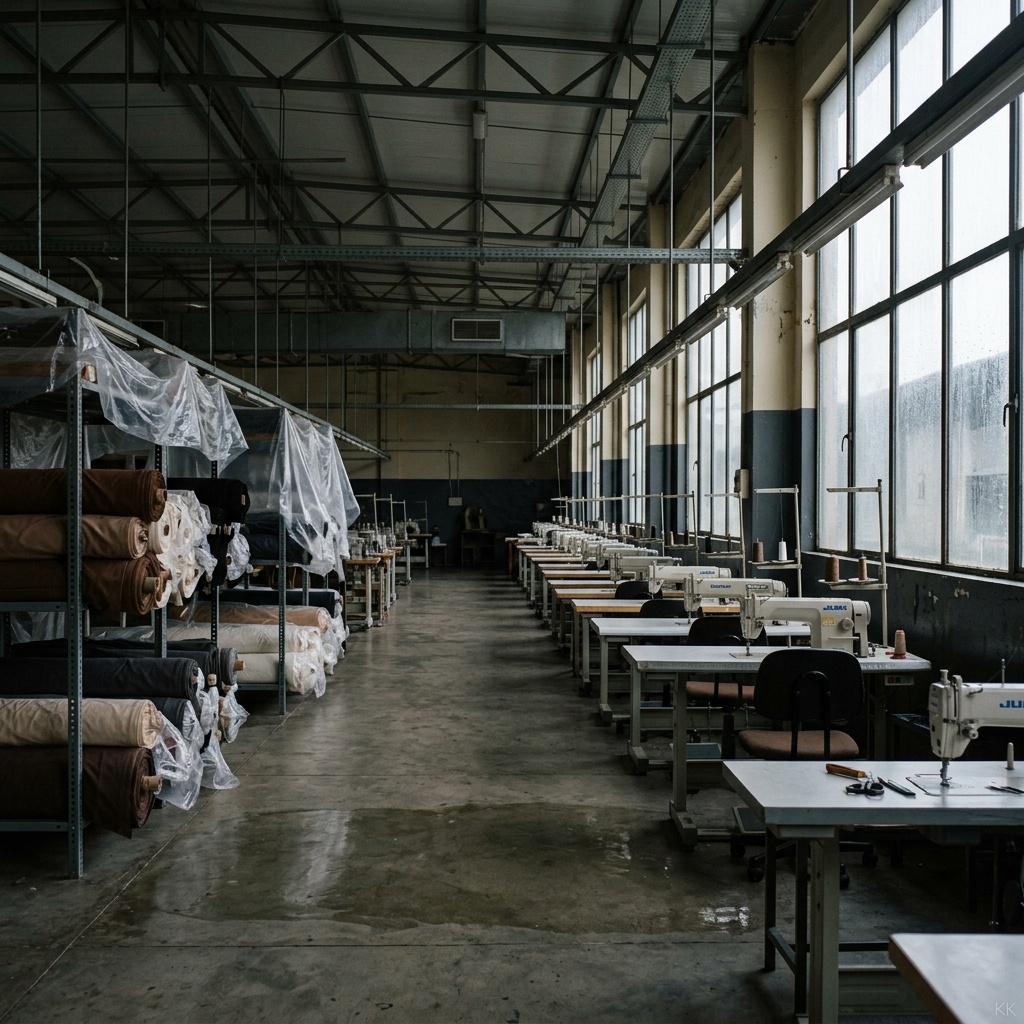
The South Asian summer monsoon runs roughly June 1 through September 30 (per India Meteorological Department reporting). For the major apparel-manufacturing hubs — Tirupur, Bangalore, Noida, Ludhiana, Dhaka, Chittagong — that window collides head-on with peak production for US holiday and Q1 stock.
The math is unforgiving. A bulk run that arrives at a US warehouse in October started cutting in early August. A vessel that hits the US west coast in late November cast off from Mundra or Chittagong in mid-October.
In other words: every December delivery you're tracking right now is being made during the monsoon. The factory's monsoon discipline is your December delivery discipline — full stop.
What humidity actually does to color, drying, and finishing
Rain itself doesn't slow a sewing machine. Humidity does. Three operational things shift in monsoon, and any one of them can break a holiday SKU.
Dye absorption shifts batch to batch
A dye lot (the unit of fabric dyed together to a specific colour recipe — colour consistency is tracked at the lot level) behaves differently at 90% humidity than at 60%. The same recipe, the same mill, the same fabric — and the post-wash shade pulls warmer in some lots, cooler in others.
Brands that don't catch this in QC ship a December order where the navy jacket and the navy pant on the same model are visibly two different navies.
Drying time stretches — and finishing waits
Fabric can't be cut, sewn, or finished (the last-mile garment treatments — printing, embroidery, garment-wash, brushing, pressing — that happen after the bulk seams are stitched) while it's holding moisture. In dry months, post-dye drying is a half-day step.
In monsoon, without controlled drying, the same fabric can sit 36 to 72 hours before it's stable enough for the next stage. Each delay compounds, and the finishing window for printing or embroidery gets squeezed against the cutting deadline behind it.
GSM isn't a fixed number in humid air
Heavier fabrics absorb more atmospheric moisture. A GSM (grams per square metre — the standard fabric-weight unit) reading taken in July can differ measurably from one taken in November on the same fabric, because the cloth itself is heavier with absorbed water.
Anything weight-spec sensitive — fleece, heavy knits, midweight wovens — drifts off-spec in monsoon-only readings. Sample-vs-bulk weight discrepancies that look mysterious in spec sheets are often just humidity, measured at different points in the calendar.
“The factory's monsoon discipline is your December delivery discipline — full stop.”
The friction monsoon adds to ports, roads, and vessels
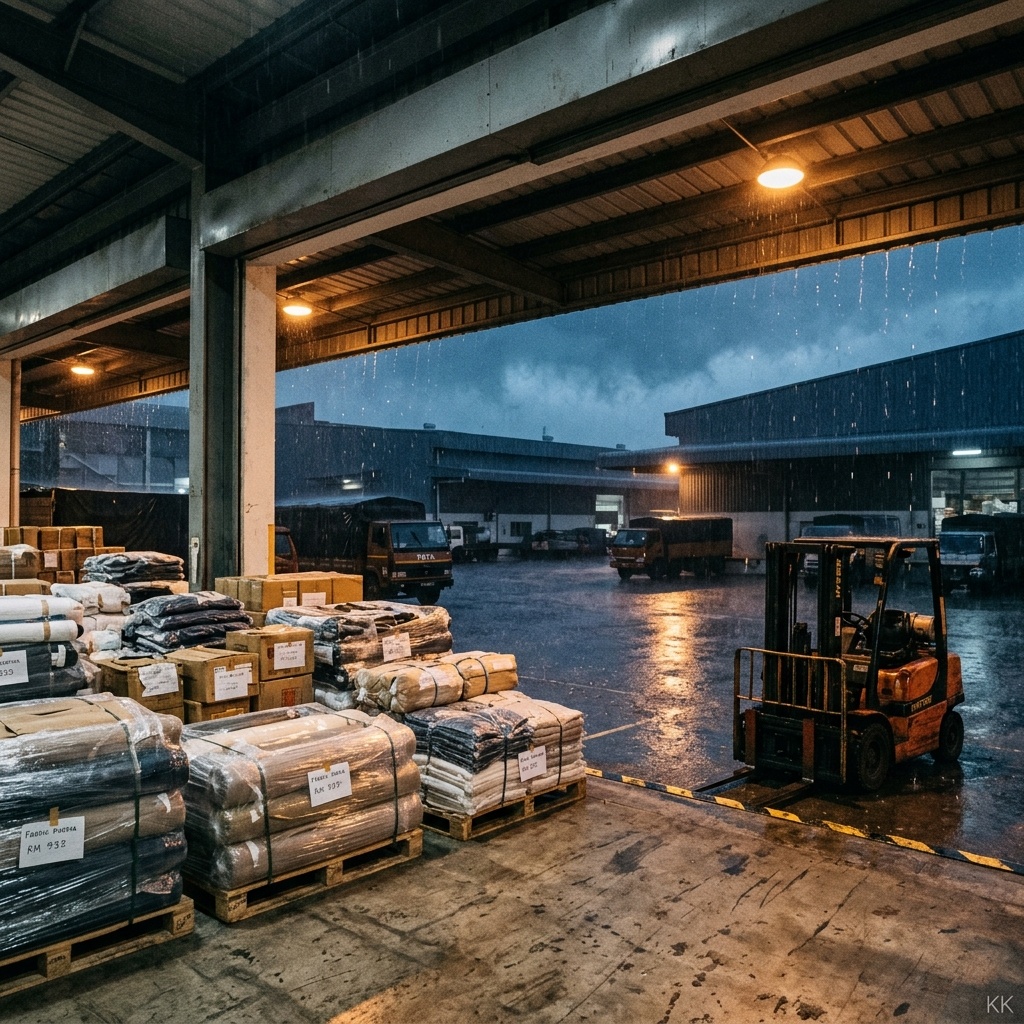
Beyond the factory, monsoon adds logistical friction that lands directly against your December deadline. Heavy rain closes inland roads in pockets of Maharashtra, Karnataka, and Tamil Nadu — sometimes for days at a time.
Cyclone warnings around the Bay of Bengal pull east-coast vessel schedules a week off, and trans-Pacific freight rates tend to peak August through October partly because every brand is rushing the same window (McKinsey's State of Fashion tracks this seasonality year on year).
None of this is unmanageable. It is manageable only if your partner is anticipating it before bookings open in late June — not negotiating around it after the rain has started.
What a monsoon-ready factory does differently
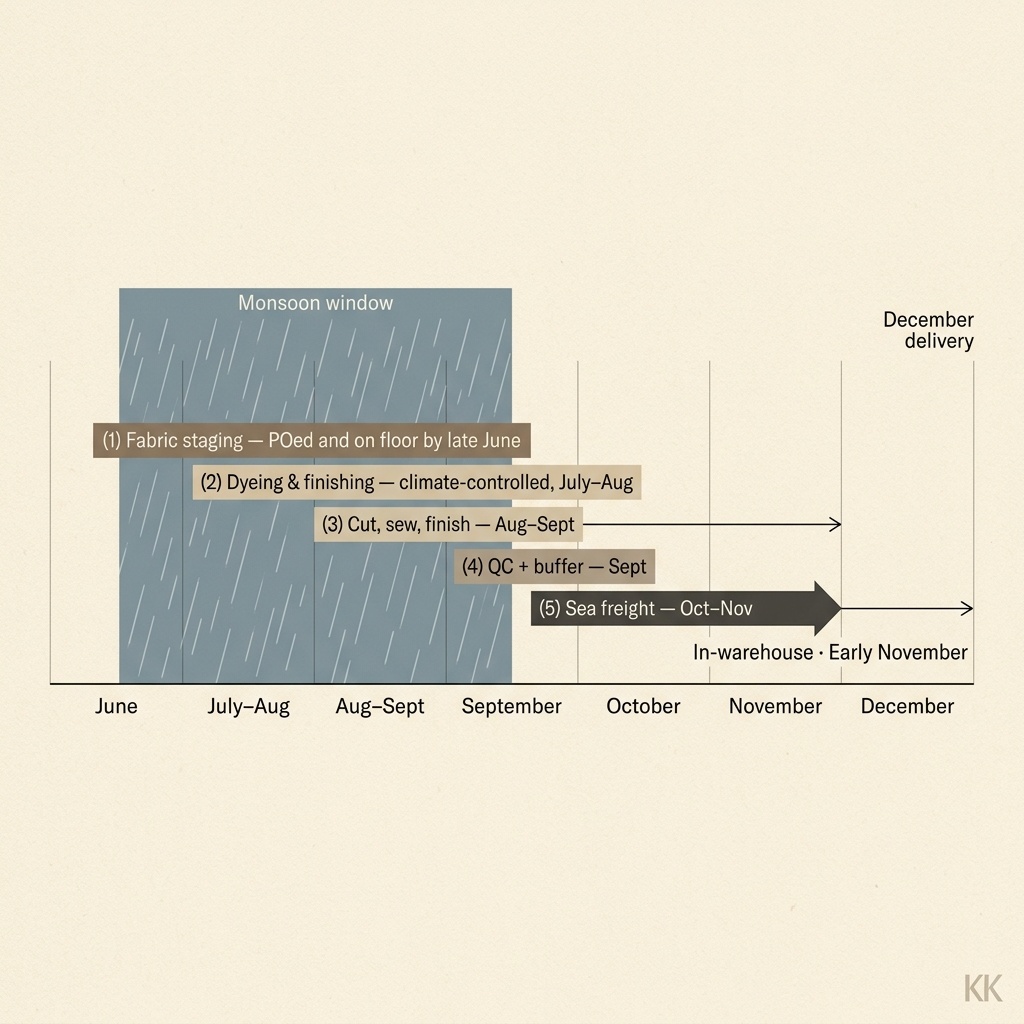
Four operational things separate a factory that handles monsoon from one that absorbs the damage as missed shipments. Use the "Signs" boxes below as a checklist when you next visit the floor or call the project manager.
1. Stages fabric before peak monsoon
Premium fabric and mill-to-order lots are POed and physically delivered to the factory before late June, when the peak rain hits. A monsoon-ready floor plans the fabric pipeline backwards from August cutting — not the other way around.
The reason: fabric in transit during peak monsoon is fabric exposed to road closures, port back-ups, and warehouse humidity it was never specified for.
Signs your factory isn't doing this
- • Fabric POs for September cutting are still being placed in July.
- • Premium fabric is in transit (not on the factory floor) when monsoon peaks.
- • The factory has no covered, climate-controlled fabric storage.
2. Finishes in controlled environments
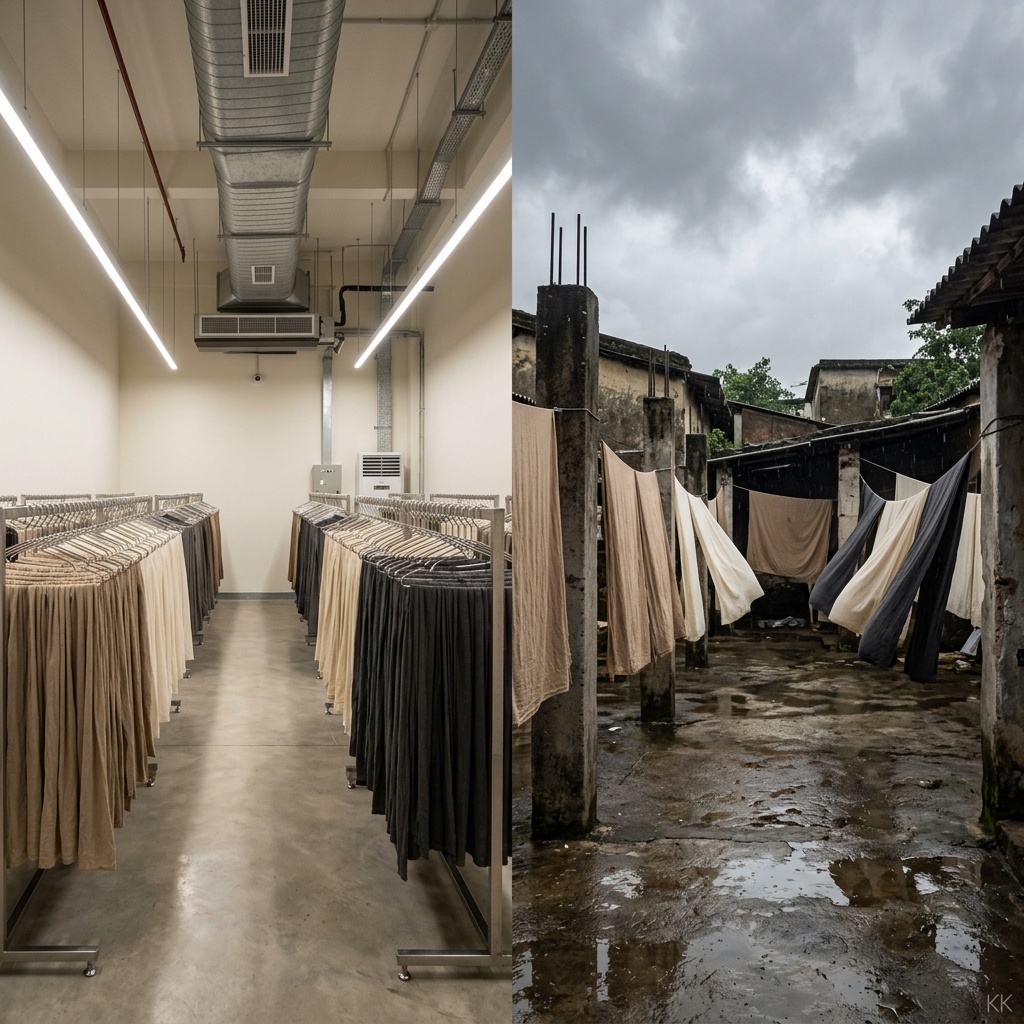
Dyeing, washing, drying, and finishing happen in climate-controlled rooms with dehumidified air — not in open-shed bays at the back of the floor. The capital cost is real. The alternative is the colour-consistency problem above, repeated across every lot.
On a site visit, ask to see the dye-and-finish room. The honest factories want to show it; the ones that don't want to are telling you something.
Signs your factory isn't doing this
- • Fabric is dried in open courtyards or on rooftop lines.
- • The factory tours you through sewing floors but skips the dye-and-finish room.
- • There's no humidity reading written on the QC sheets.
Free download
Monsoon-Season Supplier Questions
A one-page list of the exact questions to put to your sourcing partner this week — schedule, fabric drying, buffer, dye-lot management. PDF.
3. Builds a written schedule buffer
A monsoon-ready production plan has a built-in 5 to 7 day buffer between dye-finish and cut-start, and another between QC and dispatch. The buffer lives on the production sheet, not in the project manager's head.
Buffer is not slack you negotiate down. Buffer is the reason the rest of the calendar holds when one stage slips three days in a wet week. The full 90-day timeline assumes buffer; without it, the math doesn't close.
Signs your factory isn't doing this
- • The factory's production schedule reads exactly the same in July as in February.
- • "We'll catch up in August" is a sentence anyone has said aloud about your order.
- • The PM treats buffer requests as negotiation room rather than monsoon discipline.
4. Manages dye lots tightly across humidity
Dye lots are sequenced so that a single garment's colour-coordinated pieces — a three-piece tracksuit, a coordinated outerwear set — come from the same lot, dyed in the same humidity window. Mixing lots across a wet weekend is what produces the navy-jacket-navy-pant problem.
The QC sheet for every shipment names which lots fed which SKUs. If it doesn't, the factory doesn't know — and the colour-mismatch claim will arrive at your warehouse instead.
Signs your factory isn't doing this
- • There's no dye-lot reference on the QC report you receive.
- • Lot mismatches are discovered at the US warehouse, not at the factory.
- • The factory can't tell you which lots are running which SKUs this week.
When the monsoon math doesn't apply
Two scenarios where this conversation is less load-bearing.
Synthetic-heavy lines — pure polyester, nylon-blend technical wear, and most performance fabrics — are far less monsoon-sensitive than natural fibres. The fibres themselves don't absorb atmospheric moisture, drying times stay short, and dye-absorption shifts are smaller. If your line is 80%-plus synthetic, monsoon discipline is "nice to have" rather than "ship or not."
Factories with fully climate-controlled production from cut to finish — the small but growing tier of mills and units that have invested in HVAC across the entire floor — operate close to dry-season tolerances year-round. They cost more per unit. They're worth it for any brand whose colour and consistency promise is part of the price.
If neither describes your sourcing partner, monsoon discipline is the conversation. Plus-one sourcing is one way to route monsoon-sensitive categories to climate-stable geographies for the months it matters most.
What we'd do in your shoes this month
Get a written answer this week to four questions: how does the schedule change in monsoon, where does the fabric dry, what buffer is in my timeline, and how is colour held in humidity.
Compare the answers against the "Signs" boxes above. The factory with specific, line-item answers is the factory that ships December cleanly.
Treat the absence of a specific answer as the answer itself.
Read next
7 min read
What to Lock for Holiday Before the Window Closes
The three June decisions every US brand has to lock now.
9 min read
The US Plus-One Sourcing Playbook
Why adding a second country beats moving — and which to add.
9 min read
Why US Fashion Brands Are Leaving China in 2026
The tariff math, the alternatives, and the brands moving first.
Comments
No comments yet
Be the first to share your thoughts!